

PLA 3D Printing Guide: Properties and Uses

PLA (Polylactic Acid) is the most widely used 3D printing filament in the world, and it is the material we reach for most often when Charlotte, NC clients need visual prototypes, display models, or presentation-ready parts. It delivers excellent surface finish, reliable dimensional accuracy, and a fast turnaround at a price point that fits budgets of any size. In this guide, we break down everything you need to know about PLA so you can decide whether it is the right material for your next project.
What Is PLA?
PLA stands for Polylactic Acid, a thermoplastic polyester derived from renewable resources like cornstarch and sugarcane. Unlike petroleum-based plastics such as ABS, PLA is biodegradable under industrial composting conditions, which makes it a popular choice for teams that value sustainability. It was originally developed for medical implants and food packaging, but its ease of use and print quality quickly made it the default filament for FDM (Fused Deposition Modeling) 3D printing.
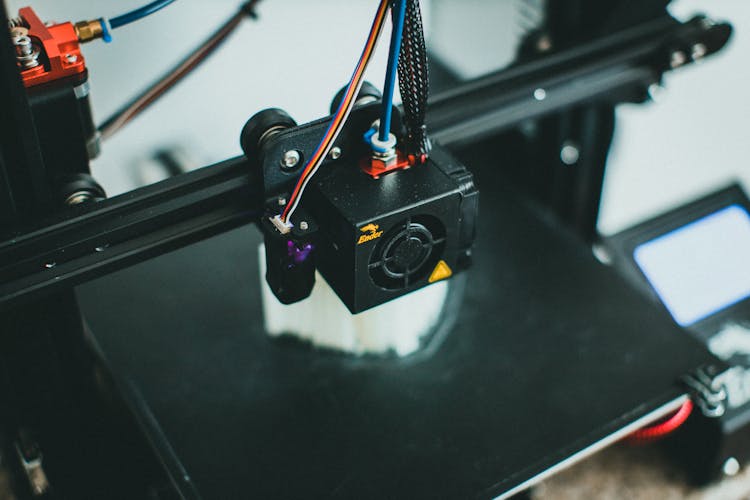
PLA melts at a relatively low temperature, adheres well to most build surfaces, and produces minimal odor during printing. These characteristics make it the most forgiving material to print with and the go-to recommendation for everything from quick concept models to high-detail architectural miniatures.
Key Properties of PLA
Understanding PLA’s technical properties helps you determine whether it will perform in your specific application. Here is a quick reference table.
| Property | Value |
|---|---|
| Print Temperature | 190-220°C |
| Bed Temperature | 0-60°C (heated bed optional) |
| Tensile Strength | ~37 MPa |
| Flexural Modulus | ~4 GPa |
| Elongation at Break | ~6% |
| Heat Deflection Temp | ~56-60°C |
| Density | 1.24 g/cm³ |
| Shrinkage | Very low (~0.3%) |
| Biodegradable | Yes (industrial composting) |
| UV Resistance | Low |
The standout numbers here are PLA’s very low shrinkage rate and its modest heat deflection temperature. Low shrinkage means parts come off the printer close to their designed dimensions with minimal warping, which is a significant advantage for prototyping. The low heat resistance, however, is the primary limitation you need to plan around.
Best Applications for PLA
PLA is the right material when appearance, dimensional accuracy, and speed matter more than mechanical toughness or thermal performance. Here are the applications where it excels.
Visual prototypes. When Charlotte, NC product teams need a physical model to evaluate form factor, ergonomics, or aesthetics before committing to production tooling, PLA delivers crisp detail and a smooth surface that represents the final product well.
Display models and presentation pieces. Trade show models, investor pitch prototypes, and showroom display items all benefit from PLA’s excellent surface finish and wide color selection. We print presentation-quality models for businesses across the Charlotte metro area and throughout North Carolina.
Architectural and scale models. PLA’s dimensional stability and fine-detail capability make it ideal for architectural firms producing scale models of buildings, landscapes, and interior layouts. Several architecture practices in the Lake Norman, NC area rely on our PLA printing for client presentations and design reviews.
Educational projects and teaching aids. Schools, universities, and training facilities use PLA parts for classroom demonstrations, anatomical models, and engineering coursework. It is non-toxic, low-odor, and safe to handle without special precautions.
Packaging inserts and custom organizers. Low-volume packaging inserts, product cradles, and drawer organizers are well-suited to PLA because they stay indoors, experience minimal stress, and benefit from PLA’s cost efficiency.
PLA Strengths
PLA has earned its position as the most popular 3D printing filament for several practical reasons.
- Easy to print. PLA is the most forgiving FDM material. It prints at lower temperatures, adheres to unheated build plates, and tolerates a wide range of print settings without failing. This translates to fewer failed prints and faster turnaround for your project.
- Excellent surface finish. PLA produces smooth, detailed surfaces with well-defined edges. Layer lines are less visible than with most other filaments, and the material sands and finishes well for post-processing.
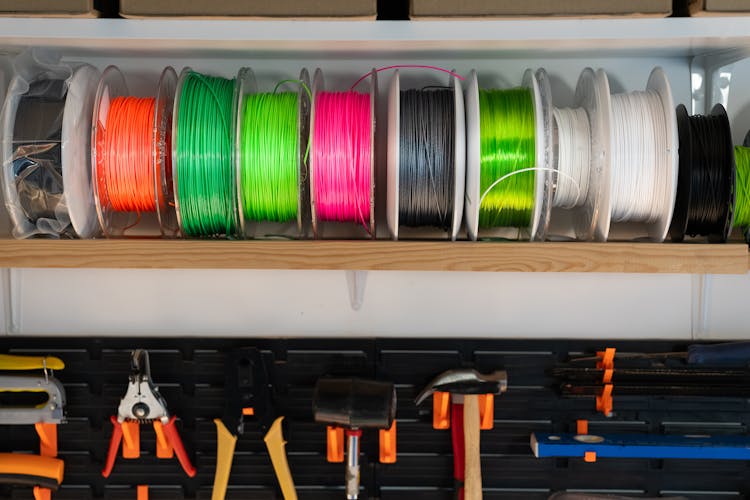
- Wide color range. PLA is available in more colors, finishes, and specialty variants (matte, silk, wood-fill, marble) than any other filament. This makes it easy to match brand colors or achieve specific visual effects.
- Low warping. With a shrinkage rate around 0.3%, PLA parts maintain tight dimensional accuracy even on large flat surfaces where other materials tend to curl.
- No heated bed required. PLA adheres reliably to an unheated build plate with basic adhesion aids, which simplifies the printing process and reduces energy costs.
- Biodegradable. PLA breaks down under industrial composting conditions, making it a more environmentally responsible option than petroleum-based alternatives.
- Low cost. PLA filament is among the least expensive 3D printing materials, keeping per-part costs down for budget-conscious projects.
PLA Limitations
PLA is not a universal solution. Understanding where it falls short prevents costly surprises down the line.
- Brittle under impact. PLA has low elongation at break (~6%), which means parts tend to crack or shatter under sudden impact rather than flex. If your part will be dropped, knocked around, or subjected to repeated mechanical stress, consider PETG instead.
- Low heat resistance. PLA begins to soften around 56-60°C. In Charlotte, NC, a car interior on a summer afternoon easily exceeds that threshold. Parts left in direct sunlight, near heat sources, or in enclosed vehicles will warp and deform.
- Not ideal for functional or outdoor parts. Between its brittleness and heat sensitivity, PLA is a poor choice for load-bearing brackets, snap-fit assemblies, outdoor enclosures, or any component that lives in a demanding environment.
- Moisture absorption over time. PLA is hygroscopic and will absorb ambient moisture, which can gradually degrade mechanical properties and surface quality over months and years. For long-term functional use, more durable materials are a better investment.
- Low UV resistance. Extended exposure to sunlight causes PLA to become brittle and discolor. Outdoor applications in North Carolina’s climate will deteriorate noticeably within weeks.
PLA vs Other Materials
PLA is one piece of a broader material toolkit. Here is how it compares to the two other most common FDM filaments.
PLA vs PETG. PETG offers significantly better impact resistance, chemical resistance, and heat tolerance (up to ~80°C) at a modest increase in cost and print complexity. If your part needs to function in the real world rather than sit on a shelf, PETG is usually the better call. Read our full PETG material guide for details.
PLA vs ABS. ABS provides higher heat resistance (up to ~100°C), better impact toughness, and the ability to be vapor-smoothed for a near-injection-molded finish. However, ABS is harder to print, warps more easily, and produces fumes that require ventilation. For industrial and automotive applications, ABS or its UV-stable cousin ASA is the standard. See our ABS material guide for a complete breakdown.
The short version: Choose PLA for looks and speed, PETG for real-world function, and ABS for heat and industrial demands. Our full materials comparison covers all three side by side.
When to Choose PLA for Your Project
PLA is the right material when your project checks most of these boxes:
- The part is primarily visual, decorative, or for demonstration purposes.
- It will live indoors in a temperature-controlled environment.
- Surface finish and color accuracy are priorities.
- You need fast turnaround and low per-part cost.
- The part will not bear significant mechanical loads or experience impact.
- You are in the early stages of prototyping and need to iterate quickly before committing to a tougher material for the final version.
If your application involves heat, outdoor exposure, mechanical stress, or long-term functional use, we will typically steer you toward PETG, ABS, or nylon depending on the specific requirements.
Explore Our Other Material Guides
Need something tougher than PLA? Explore our other material guides:
- PETG Guide - Step up to functional parts with impact and chemical resistance
- ABS Guide - High heat resistance and vapor-smoothable surface finish
- ASA Guide - UV-stable for outdoor and weather-exposed applications
- TPU Guide - Flexible, rubber-like parts for gaskets, seals, and grips
- Resin Guide - Ultra-fine detail for miniatures, jewelry, and precision parts
- Full Materials Comparison - All materials compared side by side with specs
Get Started with Your PLA Project
Whether you are a Charlotte, NC startup building your first prototype, a North Carolina manufacturer producing display samples, or an architect preparing a client presentation, PLA gives you professional-quality parts on a practical timeline and budget. At CLT 3D Printing, we help businesses across Charlotte, the Lake Norman corridor, and the greater North Carolina region turn ideas into physical parts quickly and reliably.
Ready to get started? Submit your files for a free quote, or explore our full materials comparison guide to see how PLA stacks up against PETG, ABS, and other options for your specific application.
Related Articles
Waterproofing 3D Prints: Methods & Materials
Learn proven techniques to make FDM 3D printed parts waterproof for outdoor and liquid-contact applications.
Temperature Control Secrets for FDM Success
Master temperature settings for FDM printing. Learn optimal temps for PLA, PETG, and ABS to get quality parts.
Engineering Grade Plastics Cost Less Than You Think
Engineering plastics like PETG deliver professional results without premium pricing. Learn smart material selection.